Detailed case study
Move from “is the battery still good?”
tothe system knowing which cell will fail first.
We rebuilt the BMS for our client's electric scooters — from hardware-only protection to smart battery lifecycle management. Risk cells are flagged before they fail, so after-sales shifts from reactive repair to proactive operations.
The client had the hardware,
but battery management was still“good enough to ship”
Before we started, the client already had battery hardware, controllers and vehicle telematics. But as the fleet scaled, the unobservable and unpredictable parts of the battery layer started compounding.

Delivery riders run two to three deep charge-discharge cycles a day — battery degradation runs far faster than for typical users.
The real concern was never whether the batteryhad charge left.
— it waswhen one would suddenly drop voltage, swell, lose range, or fail outright.
- 01Battery hardware
- 02Controller system
- 03Vehicle telematics
- 04Basic protection logic
After a batch of vehicles ran sustained high loads through the summer, a localized group of cells started showing abnormal temperatures.
“The dangerous part wasn't the fault itself — it was that we had no idea which cells had already started misbehaving.”
Six dimensions —
battery management, redefined
No longer "prevent the battery from breaking," but "understand when the battery starts to degrade."
It wasn't "no monitoring"
— the system simplydidn't know the battery was degrading
The client already had collection boards, temperature sensors, CAN bus and basic protection — but that's basic protection, not smart management.
Riders see "40% left"
but the scooter won't move
The most dangerous problems
often come fromthe smallest cell anomaly
A classic "weakest-link" effect — one cell running a bit hot and dropping voltage faster drags down the entire pack.
Human after-sales can't keep up with fleet growth
We didn't build another protection system
because"protection ≠ management"
A hardware-protection view
- Add alarm thresholds
- Add protection logic
- Add hardware detection
- Cut power when something breaks
Smart battery lifecycle management
- Millisecond cell samplingDetects 1mV shifts
- Adaptive SOC / SOH scoringDynamic correction model
- Active balancing + thermal controlLevels cell voltage spread
- Cloud-based remote operationsFaults caught before they happen
Four stacked layers —
the smart BMS technical stack
From sensing at the bottom to applications at the top — every layer serves "understanding the battery."
The hard part isn't collecting data —
it'sstaying stable in real-world riding
- Direct sun, high heat
- Frequent hard acceleration
- Back-to-back deep cycling
- Sustained high loads
- Variable riding styles
Four core capability chains
stitched into a system thatactually understands batteries
Live cell-state sampling
Voltage modules, current sensing, temperature probes and CAN bus capture voltage, current, temperature and charge state in real time.
Adaptive SOC / SOH scoring
Layer adaptive SOC estimation, SOH scoring, degradation models and load-induced voltage-sag analysis on top of static algorithms.
Active balancing and thermal control
Cell balancing, thermal strategy, dynamic power throttling and charge/discharge protection — keeping consistency, temperature stability and lifespan.
Cloud-based remote operations
Wireless modules, cloud server and OTA data sync handle remote monitoring, fault alerting, health tracking and fleet-wide management.
Mid-summer, a rider's scooter running flat-out for hours
The system detected a cell group showing rising temperature / falling discharge efficiency / abnormal voltage swings. A traditional system would have waited until temperature crossed a hard limit before alerting. This time —
Mini program + console —
operations as simple as reading a dashboard
Field operators run daily checks from the mini program; the operations team manages the entire fleet from the cloud dashboard.
Basic info
Connectivity, device ID, IMEI, SIM expiry and ICCID — visible on one screen.
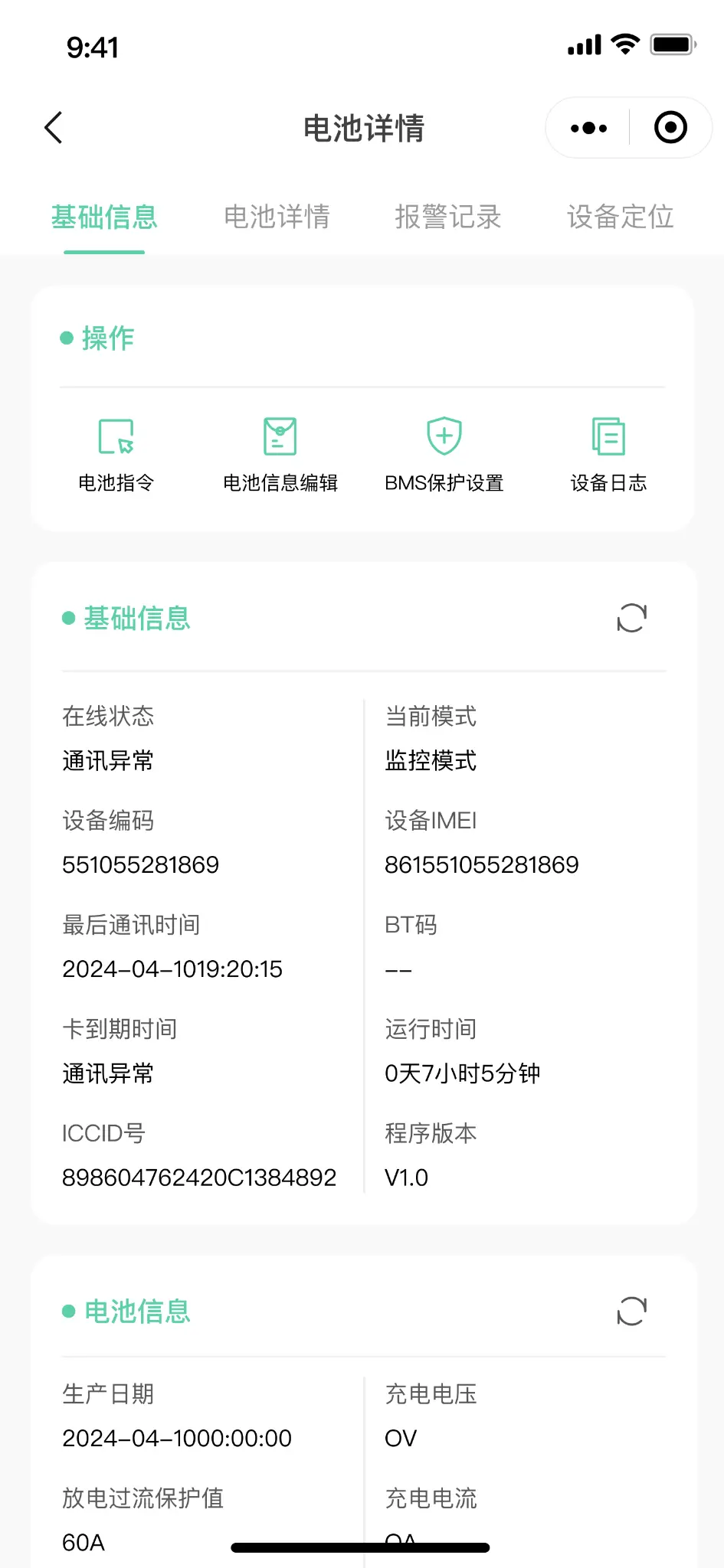
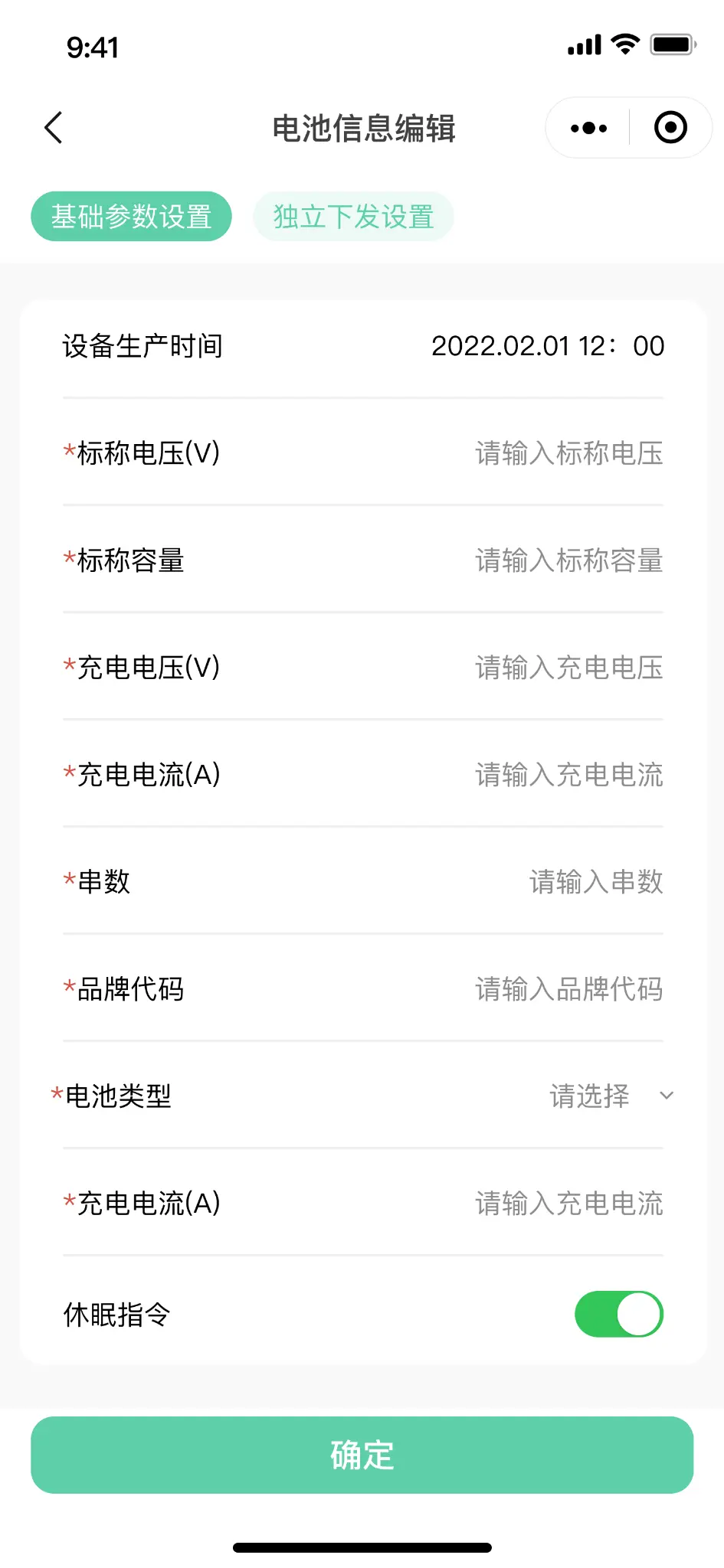
Push parameters, bind to brand codes
Push nominal voltage, capacity and charging parameters remotely, with sleep commands and per-device overrides.
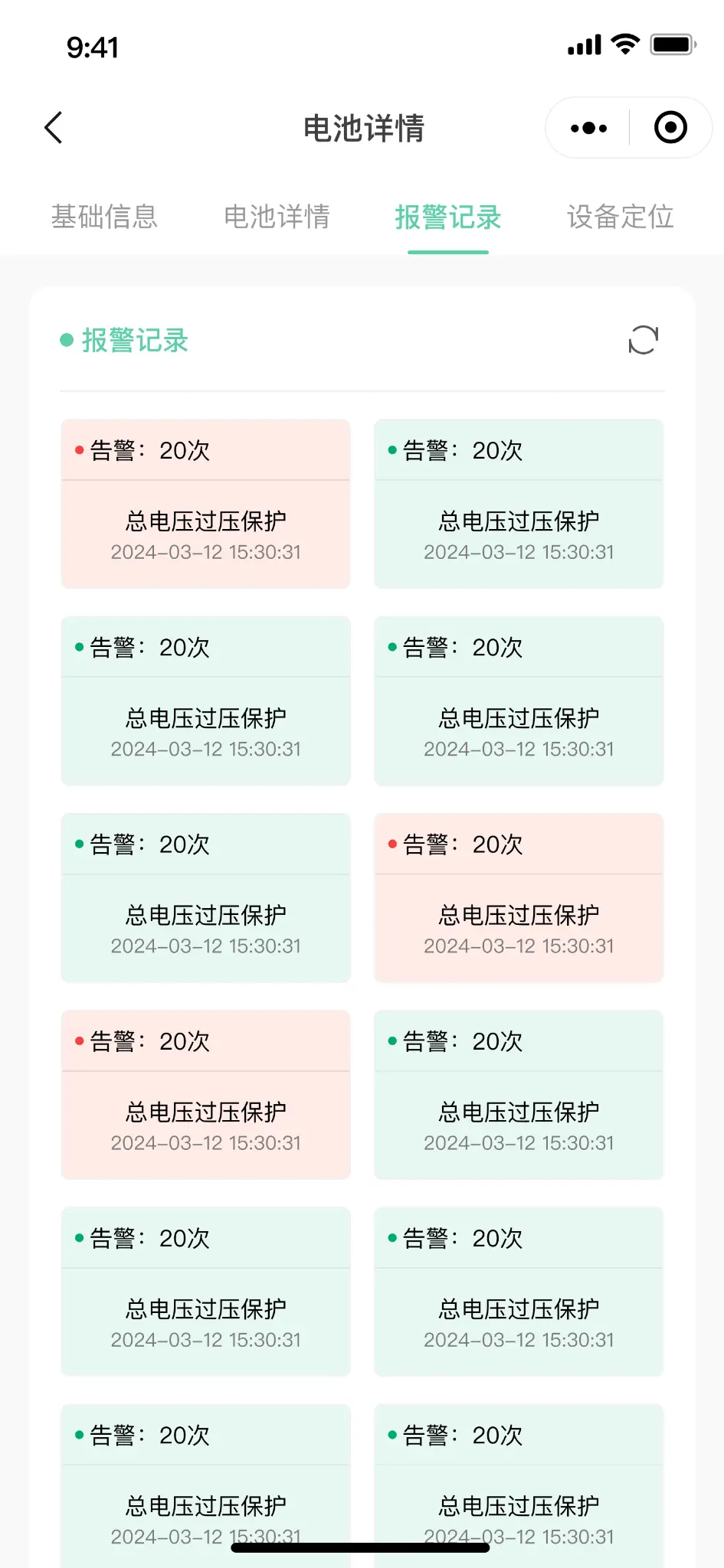
Color + count + time, in one view
Red flags high risk, green marks resolved — operators pinpoint problem vehicles at a glance.
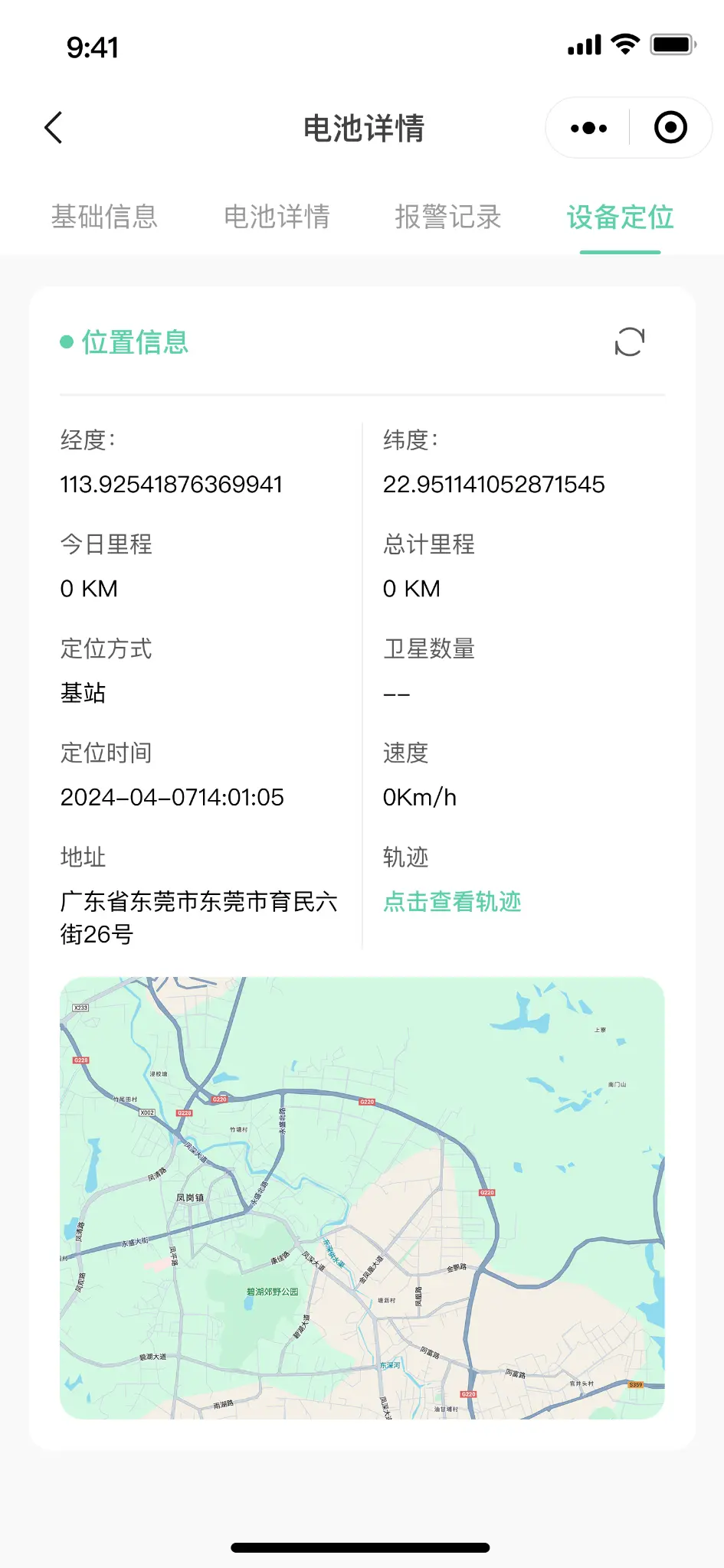
Coordinates + route + mileage
Combines positioning method, satellite count and timestamp, with route playback and daily mileage.
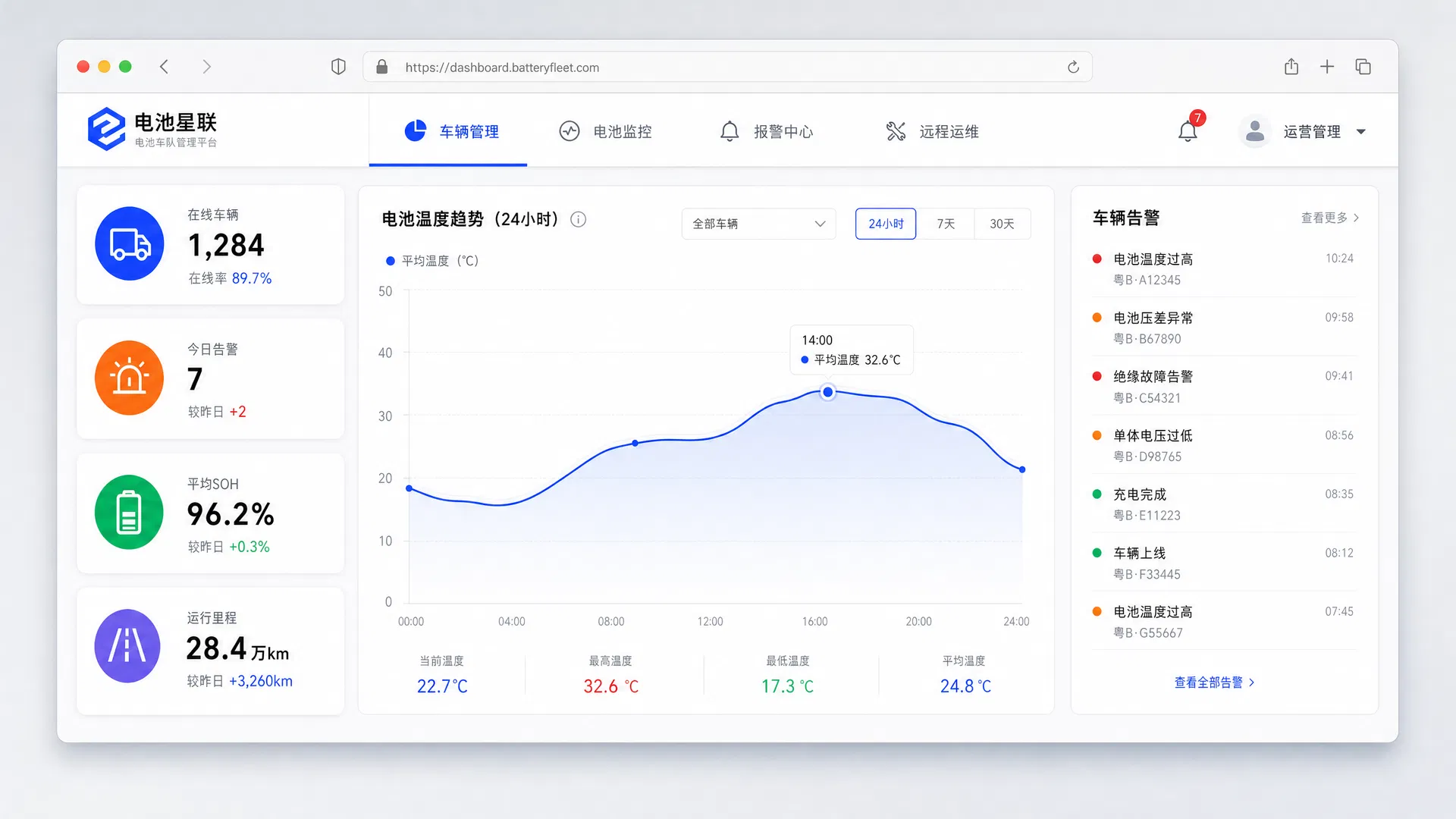
Operations at scale
starts here
Fleet overview, temperature trends, alert center and remote operations — aggregated, filterable by fleet, model and rider.
The same capability extends to
every scenario "running on a battery"
Same core method: let the system understand the battery before users do, and before failure does.
Move from "is the battery usable" to "the system knows the battery's current state."
Wherever a scenario uses batteries, needs remote operations and has to make users a reliability promise, this smart BMS platform fits — only the algorithms need tuning for the cell chemistry and operating profile.
No longer waiting "for the fault to happen" —
instead,managing the entire battery asset proactively
We didn't just bolt on a monitoring system —
we moved the battery business from a hardware mindset to a data mindset
"We focus on shipping AI software solutions
that actually run in production."
No jargon, no demoware. We open up each critical business scenario with you and ship an AI loop the business can actually adopt.